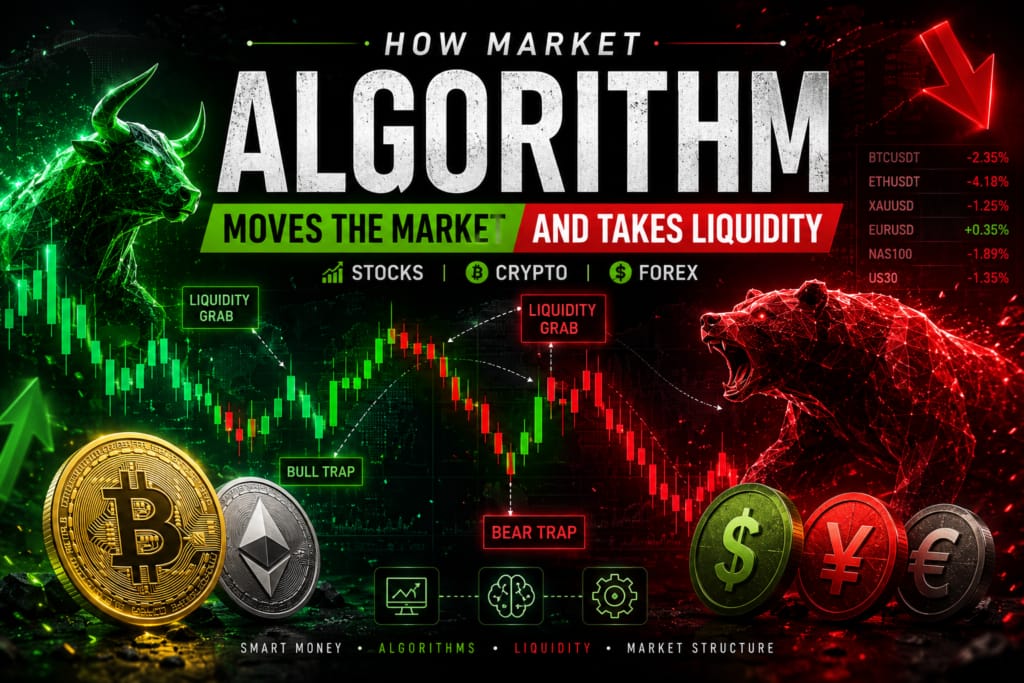
Market Algorithm – Understanding How Financial Markets Really Move
One of the most interesting topics in modern trading is the concept of the Market Algorithm. Many beginner traders believe that markets move randomly, but after spending time studying price action, market structure, liquidity, and institutional behavior, they often discover that markets tend to follow specific patterns and behaviors. This is where the idea of a market algorithm becomes important.
The term “Market Algorithm” refers to the systematic way financial markets move and react to liquidity, orders, supply and demand, and institutional activity. While no trader outside major financial institutions knows the exact programming behind every market movement, experienced traders understand that price often behaves in a structured and repeatable manner rather than moving completely at random.
About This Educational Resource
This educational resource is shared to help students, teachers, and language learners improve their reading habits, knowledge, vocabulary, and learning skills. Educational books play an important role in personal growth, academic success, and self-learning development.
Benefits of Reading This Book
Reading educational books can improve communication skills, increase understanding, support critical thinking, and help learners discover new ideas and concepts in an easy and effective way.
Why Should You Read This Book?
This book can be useful for students, beginners, teachers, and readers who want to improve their educational knowledge and develop better learning abilities through regular reading and practice.
What Is a Market Algorithm?
A Market Algorithm can be described as the underlying mechanism that drives price movement in financial markets. It is the process through which buy orders, sell orders, liquidity, and institutional participation interact to create trends, reversals, and market structures.
Large financial institutions, banks, hedge funds, and market makers process enormous amounts of trading data every second. Advanced computer systems and algorithmic trading programs execute trades automatically based on predefined conditions. These systems can influence price movement and create recurring patterns that traders often observe on charts.
This is one reason why similar chart patterns appear repeatedly across Forex, Stocks, Cryptocurrencies, Commodities, and Indices.
Why Is Understanding Market Algorithms Important?
Many traders lose money because they focus only on indicators while ignoring how the market actually functions. Understanding market algorithms helps traders see beyond simple buy and sell signals.
- Improves market understanding
- Helps identify liquidity zones
- Provides insight into institutional activity
- Enhances trade timing
- Improves risk management
- Helps avoid emotional trading decisions
When traders understand how algorithms seek liquidity and react to market conditions, they can make more informed trading decisions.
How Market Algorithms Move Price
Financial markets operate through the continuous interaction of buyers and sellers. However, large institutions require significant liquidity to execute large positions. Because of this, market algorithms often guide price toward areas where large amounts of orders are located.
These areas typically include:
- Previous highs
- Previous lows
- Support zones
- Resistance zones
- Equal highs and equal lows
- Major psychological price levels
When price reaches these areas, liquidity is collected, and the market often reacts with strong movements.
The Role of Liquidity
Liquidity is one of the most important concepts in algorithmic market behavior. Liquidity refers to areas where many traders have placed orders.
For example, many beginner traders place stop-loss orders below obvious support levels or above obvious resistance levels. Market algorithms frequently move price into these areas to trigger those orders before moving toward the intended direction.
This behavior is often referred to as a liquidity sweep or stop hunt.
Understanding liquidity allows traders to avoid becoming easy targets in the market.
Market Structure and Algorithms
Market structure is another key component of understanding algorithmic movement.
Algorithms typically create recognizable structures such as:
- Higher Highs
- Higher Lows
- Lower Highs
- Lower Lows
- Breaks of Structure
- Trend Continuations
- Trend Reversals
These structures help traders determine whether the market is bullish, bearish, or ranging.
Instead of guessing, professional traders often wait for market structure confirmation before entering trades.
How Trends Are Created
One of the most common questions among beginner traders is how trends form.
A trend develops when buying or selling pressure consistently dominates the market. Algorithms often create trends by gradually accumulating positions before moving price in the desired direction.
In an uptrend, price typically creates:
- Higher highs
- Higher lows
- Strong bullish momentum
In a downtrend, price generally creates:
- Lower highs
- Lower lows
- Strong bearish momentum
Recognizing these patterns allows traders to align themselves with the market rather than trading against it.
Algorithmic Manipulation and Smart Money
Many modern trading concepts such as ICT (Inner Circle Trader) and Smart Money Concepts (SMC) focus heavily on understanding algorithmic behavior.
According to these concepts, institutional participants often manipulate price temporarily to create liquidity before moving the market toward their true objectives.
Common examples include:
- False breakouts
- False breakdowns
- Liquidity grabs
- Stop hunts
- Market maker traps
This is why experienced traders often wait for confirmation rather than entering immediately when price breaks a level.
Can Market Algorithms Predict the Future?
No market algorithm can guarantee future price movement with complete accuracy.
The goal is not prediction but probability. Traders use their understanding of market behavior to identify high-probability opportunities while managing risk effectively.
Successful trading is based on probabilities, not certainty.
Common Mistakes Beginners Make
- Ignoring market structure
- Trading emotionally
- Chasing every market move
- Ignoring liquidity concepts
- Using excessive leverage
- Entering trades without confirmation
- Overcomplicating analysis
Most beginner mistakes occur because traders focus on quick profits rather than understanding how markets actually operate.
Final Thoughts
The concept of the Market Algorithm helps traders understand that financial markets often move in a structured and logical way. While markets may appear random at first glance, deeper analysis reveals recurring patterns driven by liquidity, institutional activity, market structure, and order flow.
By learning how algorithms seek liquidity, create trends, and interact with market participants, traders can develop a stronger understanding of price action and improve their decision-making process. The goal is not to predict every market movement but to recognize high-probability opportunities while managing risk professionally.
As you continue your trading journey, understanding market algorithms will become one of the most valuable skills for interpreting market behavior and navigating financial markets with greater confidence.
📚 Related Books


Join Our Facebook Learning Groups
🇩🇪 Learn German Free 🇬🇧 English Learning Group 🇪🇸 Spanish Learning GroupJoin our educational Facebook communities to improve your language skills, practice daily conversations, and connect with learners from around the world.